
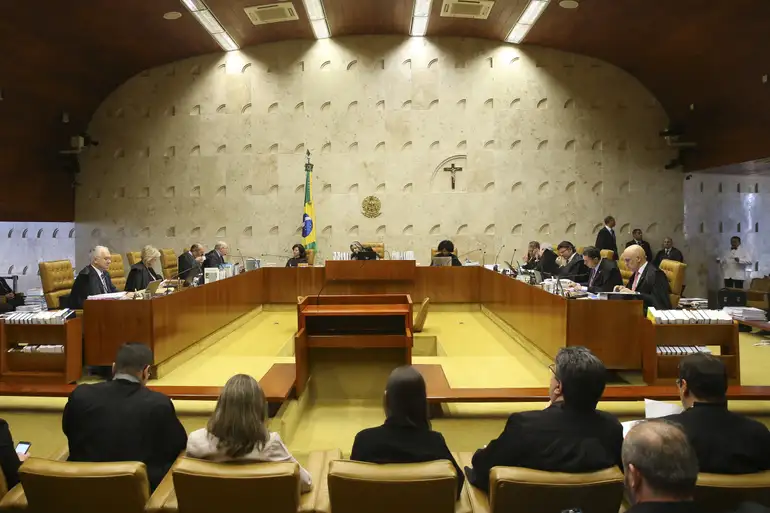
The Brazilian Supreme Court (STF) will have to analyze at least 15 cases discussing tax changes that came with the tax reform and other regulations instituted by the government in line with so-called tax justice. These cases deal with profits and dividends, high incomes, reduction of tax benefits, and presumed profit. There are 14 direct actions of unconstitutionality (ADIs) and one claim of non-compliance with a fundamental precept (ADPF), according to a survey conducted by the law firm Daudt, Castro e Gallotti Olinto.
Of the 15 cases, five discuss tax reform which, in addition to bringing simplification, should end the tax war between states. The new rules establish the collection of the new taxes – the Tax and Contribution on Goods and Services (IBS and CBS) – at the location where consumption occurs (destination), and not where the company is headquartered (origin). Thus, the measure eliminates the advantage that existed in attracting companies through the granting of tax benefits.
The proceedings in the Supreme Federal Court (STF) involve both Constitutional Amendment (EC) No. 132 of 2023 and the regulations that implemented it, such as Complementary Law (LC) No. 214 of 2025, which created the CBS (federal), the IBS (state and municipal), and the Selective Tax (federal), and LC No. 227 of 2026, which established the IBS Management Committee. The tax reform is being implemented gradually, and 2026 is considered a test year by the government itself. However, the collection of the CBS, which will replace the PIS and Cofins, will begin in 2027.
According to a survey by the law firm Daudt, Castro e Gallotti Olinto, the cases before the Supreme Federal Court (STF) are divided into four main areas: seven cases are related to the taxation of income, high incomes, profits, and dividends (ADIs 7912, 7914, 7917, 7933, 7934, and 7954, and ADPF 1334); four cases involve taxation on consumption, IBS/CBS, and preferential regimes (ADIs 7755, 7779, 7790, and 7963); three cases concern the reduction or revision of federal tax benefits and presumed profit (ADIs 7920, 7936, and 7944); and one case concerns the federal and administrative structure of the IBS (ADI 7882).
Regarding the main targets of the actions, lawyer Leonardo Gallotti Olinto, a partner at the firm that conducted the survey, believes that the tax changes were not limited to consumption and "silently affected income." "When taxation on presumed profit and dividends is increased, the government is also carrying out an income reform," he says.
The expert also details that the processes focusing on differentiated regimes, reduced rates, and zero rates in the new consumption tax system present varied themes, such as tax benefits for agricultural inputs, vehicle acquisition by people with disabilities – two cases already judged – and preferential treatment for the oil refining industry in the Manaus Free Trade Zone. According to Olinto, when it was drafted in Congress, the reform aimed to eliminate tax exemptions. Many benefits, however, were made more flexible and are now being challenged in the Supreme Court.
The litigation surrounding presumed profit, for example, is related to the understanding that this regime is considered a tax benefit. However, in Olinto's view, it is merely a method of calculating income tax. “Either you pay based on actual profit or you pay based on presumed profit. It's not a tax incentive at all; a company under the presumed profit regime can pay more tax than if it were under the actual profit regime. This is because you have a fixed base, regardless of the final result; you will pay that tax,” states the lawyer.
Regarding the legal challenges to the administrative structure of the reform, one lawsuit concerns the review of the careers of state tax auditors, who are requesting equal pay with federal government employees for their participation in the IBS Management Committee. "This is already a discussion that isn't even about the taxpayer; it's about the public servants themselves wanting a higher salary," says the tax expert.
Leonardo Gallotti Olinto also warns that other aspects of the reform that create legal uncertainty are being challenged in other courts besides the Supreme Federal Court (STF). He adds that lawsuits involving other issues are still expected to be filed, such as the question of the effective tax rate.
“Imagine a service company that pays between 2% and 5% in ISS (municipal service tax) and will pay 18% in IBS (tax on goods and services). We will have a number of companies that will not survive or will survive due to price increases. So, I think the tax reform did not guarantee legal certainty. Even before it begins, this list of lawsuits exists,” he states.
From a different perspective, Tattiana de Navarro, a tax lawyer at Oliveira Navarro Advocacia and tax affairs attorney for the OAB-DF (Brazilian Bar Association, Federal District chapter), believes that the current volume of cases is a natural consequence of the implementation of the tax reform and the tax choices approved by the National Congress. She also points out that the Supreme Federal Court (STF) is signaling that it will maintain or modify the reform according to constitutional guidelines.
“The Supreme Federal Court (STF) is very important in this tax game. It will truly be the benchmark. Several discussions will go up to it, especially when the reform is put into practice. Many other issues will still arise, when the tax authorities start denying some credit, denying some regime, or denying some tax procedure. It is very important that we pay close attention to the decisions of the STF, especially those that are heavily based on concepts,” says the lawyer.
Tattiana further complements this with a direct action of unconstitutionality (ADI 8002) recently filed by the National Confederation of Industry (CNI). It addresses sections of Complementary Law No. 224 of 2025. In the action, the institution questions a provision that reinstated taxes on operations previously benefiting from exemption or zero rate, but maintained the prohibition on the purchaser's use of tax credits.
“What was pointed out in this ADI (Direct Action of Unconstitutionality) is the creation of a tax on a tax. This is prohibited by the reform. I believe that, among all the actions, this is the one that causes the most legal uncertainty. The others are more a fine-tuning of legal interpretation,” says the OAB (Brazilian Bar Association) prosecutor.
Recently, the Brazilian Supreme Court (STF) reached a conclusion in two cases challenging aspects of the tax reform. One concerned the maintenance of tax benefits for agricultural inputs, including pesticides, and the other concerned the limitation of the zero-rate IBS and CBS on vehicle purchases by people with disabilities. According to José Luis Ribeiro Brazuna, a tax lawyer and partner at Bratax and professor of tax law, this could encourage the filing of new lawsuits against the reform.
The professor emphasizes that the reform foresaw the institution of tax consultation, but that it has not yet been regulated. "It would be an important channel for taxpayers to resolve their doubts before taking disputes to the Judiciary. Therefore, we may see an increase in litigation due to the absence of a channel to resolve doubts with the administration itself," says Brazuna.
The Attorney General's Office (AGU), which is a party in all lawsuits involving tax reform, was contacted by Valor, but did not respond by the time of publication.
Source: JOTA