
The election of ministers Luis Felipe Salomão and Mauro Campbell Marques to lead the Superior Court of Justice (STJ) for the next two years marks the rise of a well-tuned and experienced duo, with complementary careers that literally span from Public to Private Law.
They arrive at the highest position in the court unanimously and with a consistent discourse of unity and responsibility. More than that, they have confidence – if not from the entire court, then among themselves.
These are two politically astute ministers whose affinity dates back a long time. By a twist of fate, they were sworn in together at the Superior Court of Justice (STJ) on June 17, 2008. On the same day, Minister Og Fernandes, who would be the "natural successor" to the presidency according to the seniority criterion, also took office, but he expressed his intention not to be listed as eligible, considering that he is retiring in the next semester. Therefore, the most senior minister on the seniority list became Minister Salomão.
Salomão received the election results calmly and showed happiness, especially to Ministers Benedito Gonçalves and Maria Thereza de Assis Moura, who sit next to him in the Plenary. Campbell remained focused throughout the voting, his gaze fixed on his bench, and when he learned of the result, he made the sign of the cross. He was greeted at that moment by Og Fernandes and Raul Araújo.
The change of leadership is scheduled for August, when Minister Herman Benjamin, the current president, finishes his term at the head of the Court. If the situation remains as it is today, Benjamin will leave office in a better position than when he entered, considering that he was praised by his colleagues for his conciliatory tone and the way he conducted himself during his presidency.
Ahead
In recent years, the stance of those presiding over the Superior Court of Justice (STJ) has been more reserved, a view that the new administration is expected to reinforce, according to JOTA sources with connections to the court. One of the reasons for this is that Salomão and Campbell will assume their positions at a sensitive time, dealing with issues beyond their control, such as the investigation into the sale of court rulings.
There are also issues that need to be monitored, at the risk of attracting more attention to the court. This is the case with the involvement of ministers' relatives in high-profile cases in the higher courts, which has been causing unease and even internal reservations.
The ministers arrive at the STJ (Superior Court of Justice) leadership with high expectations from lawyers and members of the legal community, especially because they are considered "complementary to each other." Salomão was a member of specialized panels in Private Law (4th Chamber and 2nd Section), and Campbell Marques was a member of the 2nd Chamber and the 1st Section, specialized in Public Law.
Salomão was a judge and justice of the Court of Justice of Rio de Janeiro (TJRJ) and a public prosecutor in São Paulo. He served on the Superior Electoral Court (TSE) in the last elections. Then, in 2022, he assumed the position of National Justice Ombudsman, with agendas focused on the implementation of public policies, such as land regularization and access to documentation for vulnerable people.
Among other topics, the Superior Court of Justice (STJ) reported on cases in which the 2nd Section considered the list of procedures of the National Supplementary Health Agency (ANS) to be exhaustive, thus eliminating the obligation of health plan operators to cover treatments not included in the list (EREsp 1.886.929 and EREsp 1.889.704). It also reaffirmed that there is no express prohibition against same-sex marriage in the Civil Code (REsp 1.183.378).
The Civil Code, arbitration, and other business law issues are within the scope of interest of the minister, who chaired two committees of legal experts in the Senate. One of them drafted the preliminary bill for the reform of the Civil Code, and the other proposed the expansion of arbitration and the creation of mediation.
Mauro Campbell, in turn, was a member of the Public Prosecutor's Office of Amazonas, serving as a prosecutor and attorney general, as well as Secretary of Justice and Public Security. He also held positions such as full member of the TSE (Superior Electoral Court) and Inspector General of the Federal Justice System.
The minister also chaired two Senate committees responsible for proposing rules to reduce bureaucracy in public administration and drafting the preliminary bill to reform the Law on Administrative Impropriety. Furthermore, he was one of the most active advocates for the creation of the "relevance filter," established by Constitutional Amendment (EC) 125/2022, as a way to better regulate the admissibility of special appeals to the Superior Court of Justice (STJ). This mechanism still needs regulation by the National Congress to be implemented and has been stalled since 2022.
In terms of relevant rulings in the Superior Court of Justice (STJ), the minister reported on the appeal that established rules for redirecting tax enforcement to partners in cases of irregular dissolution, especially in cases of non-tax debts (REsp 1.371.128). He also reported on the repetitive appeal that defined theses on the statute of limitations in tax enforcement proceedings (REsp 1.340.553 – Topic 566).
Election calendar
In Tuesday's session, Minister Benedito Gonçalves was also nominated as the National Inspector General of Justice, a position currently held by Campbell. He will have to be questioned by the Senate for the position, which is why the election took place this week. Considering the 2026 electoral calendar, the Superior Court of Justice (STJ) sought to ensure that there is sufficient time for the Senate to question the nominee.
Minister Raul Araújo was elected director-general of the National School for the Training and Improvement of Magistrates (Enfam), and Minister Sebastião Reis Júnior will be the director of the STJ Journal.
Use of electronic voting machines
The plenary session was harmonious among the ministers, who were in a fraternal mood, with laughter and jokes. Thirty-two ministers participated in the vote, with the exception of Marco Buzzi, who is suspended from his position due to accusations of sexual harassment and may be subject to disciplinary proceedings. The Superior Court of Justice (STJ) is analyzing the internal report on the case today. Earlier, Minister Nunes Marques, of the Supreme Federal Court (STF), ordered the opening of an investigation against Buzzi.
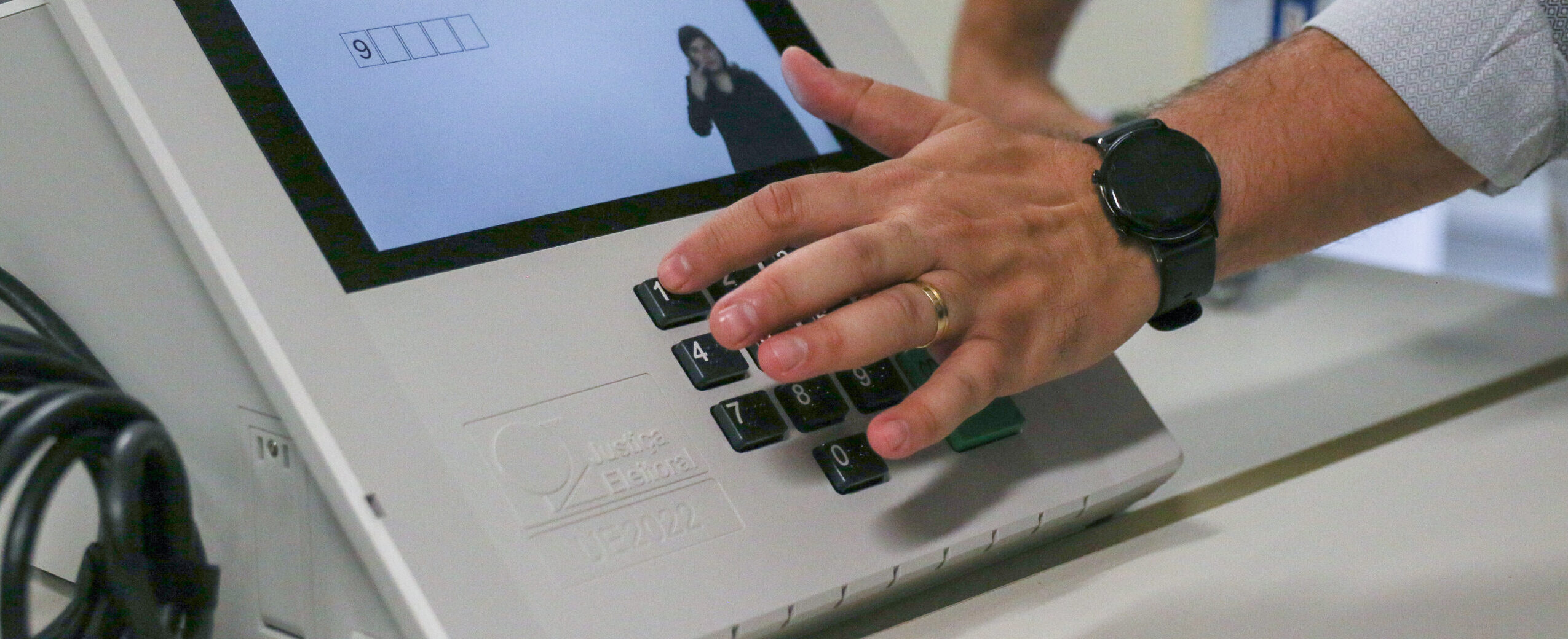
Voting at the Superior Court of Justice (STJ) is secret and considered symbolic, as the court usually follows the rule of prior election. However, the election procedure has been undergoing changes. Previously, ministers were elected by acclamation; later, they began voting with paper ballots; and, starting with the next election, they are expected to use electronic voting machines.
The measure was already planned for this election, but was postponed to the next two years, a fact that did not go unnoticed by Minister Nancy Andrighi. She suggested the use of the equipment, stating that the court has the technological infrastructure for it: "It is progress in digital terms at the Court.".
The judge made a point of saying, more than once, that some setbacks (such as the recount of votes that had to be done today) would not have been seen if the full court had been using the ballot boxes.
Source: www.jota.pro